Thursday, April 14, 2011

Self-doubt is real for entrepreneurs

This week I am reminded of one of Aesop’s fables, “The Lion, Jupiter, and the Elephant.” Even against our greatest efforts, it is easy to fall into the temporary stoop of our doubting our abilities. Entrepreneurs often wear many hats. Today we can act as the accountant, tomorrow the sales team and the day after we are PR gurus and marketing specialists. We are continuously juggling a variety of roles so often that at times it can be exhausting. You’re working your damnedest to do everything right even though it feels as if you’re doing everything wrong. And then you look over, and for a second, you get a glimpse of another entrepreneur riding the wave of success so elegantly and seamlessly, it makes you tuck your surf board between your legs and scurry back home to see if the last slice of humble pie is still in the fridge.

This week I am on overload and coasting on little sleep. So much is going on full force at work and on the home front that on Tuesday I literally hurried to the bathroom to lose my lunch just as quickly as I had ate it. I share this not so pleasant detail with you to tell the truth about navigating your way through entrepreneurism. Telling the tales of fun and achievement would be meaningless if I didn’t share the insecurities that grip you as you work to make your vision a reality. That is why the tale of “The Lion, Jupiter, and the Elephant” resonated with me so much.

For those of you who don’t know the meaningful tale, here it is: “The Lion, for all his size and strength, and his sharp teeth and claws, is a coward in one thing: he can’t bear the sound of a cock crowing, and runs away whenever he hears it. He complained bitterly to Jupiter for making him like that; but Jupiter said it wasn’t his fault: he had done the best he could for him, and, considering this was his only failing, he ought to be well content. The Lion, however, wouldn’t be comforted, and was so ashamed of his timidity that he wished he might die. In this state of mind, he met the Elephant and had a talk with him. He noticed that the great beast cocked up his ears all the time, as if he were listening for something, and he asked him why he did so. Just then a gnat came humming by, and the Elephant said, “Do you see that wretched little buzzing insect? I’m terribly afraid of its getting into my ear: if it once gets in, I’m dead and done for.” The Lion’s spirits rose at once when he heard this: “For,” he said to himself, “if the Elephant, huge as he is, is afraid of a gnat, I needn’t be so much ashamed of being afraid of a cock, who is ten thousand times bigger than a gnat.”

The line of pessimism and optimism is an edge you walk as you build a business from the ground up. We all experience self-doubt at one point. The difference is understanding that it is just a fleeting moment. Believe in yourself.

Michael Jordan, commonly lauded as the greatest basketball player of all time, had this to say about fear, “Some people get frozen by the fear of failure. They get it from peers or from just thinking about the possibility of negative results. They might be afraid of looking bad or being embarrassed. I realized that if I was going to achieve anything in life I had to be aggressive. I had to get out there and go for it. I don't believe you can achieve anything by being passive.

Michael breaks down with emotion after winning his first trophy.

"I'm not thinking about anything except what I'm trying to accomplish. Any fear is an illusion," Jordan continued. "You think something is standing in your way but nothing is really there. What is there is an opportunity to do your best and gain some success. If it turns out my best isn't good enough, then at least I'll never be able to look back and say I was too afraid to try. Failure always made me try harder the next time.”

It’s far too easy to look at others and see their excellence and wonder just how they are getting along so nicely. The truth of the matter is no one will ever be as invested in your future as you. When you have so much on the line, it is natural for doubt to sneak its way into your system. What if I don’t sell as much as I estimated? What if this doesn’t pan out as I planned? He has a well-known business and I am just starting out. How can I possibly compete with that?

These questions are common to those deeply entrenched in fulfilling their dreams. What I have learned is that in life we all must face the impossible if we are determined to set the precedent on what can be.

So don’t let the doubt that creeps into your soul at times deter you from what is head. Life is a marathon, not a sprint. Look at your temporary moments of unease as a pit stop on the way to the finish line.

Thursday, March 17, 2011

Ugly people make ugly wages?

Do good looking people enjoy more success in PR and Communications? This was a recent question posed in one of my online LinkedIn groups. While people have their own preferences when it comes to what they consider attractive, studies have shown that, in general, women and men are attracted to certain “things.” Women, on average, tend to be more attracted to men who have a relatively narrow waist, a V-shaped torso, and broad shoulders, are taller than they are, and display a high-degree of facial symmetry, and relatively masculine facial dimorphism (basically a face that visually differentiates from a woman).

Men, on average, tend to place a higher value on physical appearance in a partner than women do. Men, on average, tend to be more attracted to women who are shorter than they are, have a youthful appearance and exhibit features such as a symmetrical face, full breasts, full lips, and a low waist-hip ratio. So how does this affect your salary?

A July 2005 USA Today article by Stephanie Armour found that how you look is influential. “In a recent analysis, the Federal Reserve Bank of St. Louis reviewed various economic studies to find possible links between looks and wages. The study's conclusion: A worker with below-average looks tended to earn significantly less -- on average 9% less -- per hour than an above-average-looking employee. And those with above-average looks tended to earn 5% more than their average-looking colleagues.

courtesy of usatoday.com

 ‘If someone looks like Brad Pitt or Julia Roberts, and society values that, that attribute is built into wages,’ says Michael Owyang, an economist who worked on the analysis.”


Two people who will have no problem finding employment.

We all know that how we dress has an impact on how we are perceived – especially in a field such as media and public relations. PR gurus Jessica Kleiman and Meryl Weinsaft Cooper said it best in an article this month, “Public relations is an image business and how you look is as much your calling card as the one in your wallet.”

But we’re talking about a person’s features, not their clothes. Can your physical features hinder or propel your success? Dr. Gordon Patzer has been studying this for more than 30 years. It is what he calls the Physical Attractiveness Phenomenon, a concept devised of many years of scholarly scientific research.

“Physical Attractiveness Phenomenon can be reasonably summarized as a four step process whereby (1) appearance via physical attractiveness serves as an informational cue, (2) from which extensive information is inferred, (3) that triggers assumptions, expectations, attitudes, and behaviors, (4) causing pervasive, powerful effects/consequences that are generally beneficial for people whose appearance is higher in physical attractiveness and detrimental for people whose appearance is lower in physical attractiveness,” according to gordonpatzer.com.

To summarize some of the findings:

• Appearance is a compelling informational cue, from which extensive information is inferred, attitudes formed, and behaviors caused.

• Determinants of appearance are many and complicated: physical and non-physical, permanent and temporary, congenital from birth and developed throughout life.

• Dynamics of appearance are pervasive, powerful, and often unrecognized, unacknowledged, or denied.

• Consequences of appearance, especially as appearance is inseparable from or inextricably interrelated with physical attractiveness, are overwhelmingly in one direction.

Body Fat = Thin Pockets?

So what now? How do you proceed? First, to stay ahead of the game, I guess we would need to figure out if we’re attractive or not. So I went to the most credible online source on the issue there is …. Are-you-ugly.com. I delved headfirst into the quiz, anxious to know the results. And then, the numbers were in …I scored a 68.75 %. In attractiveness terms, according to the experts, I am a 7 on a scale of 1-10, ten being the hottest. Some would say that isn’t bad for a chunky girl. But according to the UK’s Daily Mail, my career may be in jeopardy.

I have been a plus-sized woman most of my adult life.
“Overweight women, according to medical research, are far more likely to lose their jobs. They are also more likely to be a victim of crime - or a criminal. And as if all that wasn't enough, they are also more likely to be broke.” In Africa, however, (particularly in Mauritania) large women are held in high regard. It means they come from a wealthy family (can afford food) and are fit for marriage. In fact, some men actively go out seeking the curvaceous beauties.

So in a parallel universe, if I were living in Africa with a subscription to Schwan’s, I’d be beating men and employment opportunities back with a stick. If I resided in the UK, I’d be a broke criminal. (I am booking my airline ticket to Africa as as I write.)

When it comes to physical attractiveness and salaries, I believe confidence comes more in to play. On the social effects of physical attractiveness, Wikipedia suggests, “When a person is seen as attractive or unattractive, assumptions are brought into play. Across cultures, what is beautiful is assumed to be good. Attractive people are assumed to be more extroverted, popular, and happy. This could lead to a self-fulfilling prophecy; from a young age, attractive people receive more attention that helps them develop these characteristics.”

A healthy dose of confidence can do wonders. When you feel good about yourself, you walk taller, laugh louder and are more comfortable in your skin. We all have aspects of ourselves that can cause some minor feeling of insecurity, but learning to generally appreciate who you are will yield positive results. Certified Personal and Professional Strategy Coach Jonathan Wells, agrees that confidence is important. “In reality, self-confidence is often a more important asset than skill, knowledge, or even experience … People have a natural tendency to trust you more when you seem confident. To the subconscious mind confidence equals competence. Does that seem unfair? Well ask yourself if you would hire someone who seemed unsure of their own abilities? If you needed surgery, would you use a doctor whose first impression left you wondering how he got his license to practice? It wouldn’t matter how impressive his credentials were, you would find someone else.

“Confidence creates trust, and everyone wants to be able to trust the people they do business with, become friends with and fall in love with. If you want to be trusted by others, you must first trust yourself.”

Think about it? Have you ever been around a person that just had that “it”? They weren’t necessarily drop-dead gorgeous or fit the “typical” ideals of beauty, but they had zeal, oomph, that wow factor? It’s because some people just ooze confidence and command our attention. So while I believe how you carry yourself will absolutely assist you in climbing up or falling down the success ladder, blaming it on your parent’s DNA is a little far-fetched.

We all need daily confidence boosters. We perform better when we feel better. Click here for 25 great tips. And ask yourself, what makes you feel confident?

Tuesday, February 8, 2011

Are your clients more than a number?


I am a creature of habit, of loyalty. There are things I like to be spontaneous about: travel, activities and hairstyles. Yet, there are other circumstances where I prefer to lock my feet in the cement: primary care physician, mechanic, Cottonelle toilet paper. It was hard for me to leave my pediatrician. I was around the age of 25 when I knew it was time. There I was sitting in Dr. Regina Kruczynska’s office surrounded by children playing with blocks and watching videos.


The nurse opened the door and said, “Natasha Clark,” and I was embarrassed as I rose to meet her at the door. I told this to Dr. Kruczynska when I entered and she told me not to worry. She had patients that were approaching 30. I had been her patient since I was 7. She knew my history, my parents and my son. (That was the kicker! Shaun was her patient, too. And if he had an appointment and I wasn’t feeling well, I could get a twofer and ask her to check me out, as well.) It hurt, but I eventually found a new physician.

As entrepreneurs, we should constantly be thinking about keeping our clients coming back for more. Walt Disney said, “Do what you do so well that they will want to see it again and bring their friends.” It doesn’t matter what line of work you’re in, you need and want them to come back. If you’re an author, you want them to buy the sequel. If you’re the president of UCONN, you want that student to return for the master’s degree.

“Recent estimates put each person's circle of influence at between 50 and 300 people. Imagine the time it would take a sales rep to generate 300 potential prospects," says Jay Lipe, author of The Marketing Toolkit for Growing Businesses. "Yet by connecting with a repeat customer, and finding ways for them to communicate with their circle of influence about your company, you've just expanded your sales force, without incurring additional overhead."

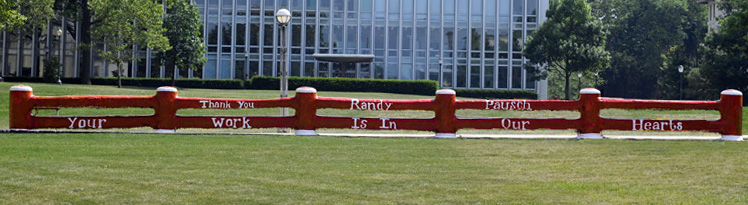
I can’t write on this topic and not mention Randy Pausch. He learned that he had pancreatic cancer in September 2006, and in August 2007 he was given a terminal diagnosis: "3 to 6 months of good health left". He gave an upbeat lecture titled "The Last Lecture: Really Achieving Your Childhood Dreams" on September 18, 2007 at Carnegie Mellon, which became a popular YouTube video and led to other media appearances. He then co-authored a book called The Last Lecture on the same theme, which became a New York Times best-seller.

A fence dedicated to Randy Pausch at Carnegie Mellon.
Pausch died of complications from pancreatic cancer on July 25, 2008. In his fantastic book, he tells readers about the $100,000 salt and pepper shaker Disney World sold. As a kid, Randy was at Disney World with his family and he and his sister decided they wanted to show their parents their appreciation for the trip. They pooled their allowance and purchased a ceramic Disney salt and pepper shaker.

However, Randy accidentally drops the shaker and it breaks. A nearby adult suggests they take it back to the store. To their surprise, the Disney employee who had sold them the items apologized for not wrapping them appropriately and gave them a new set, no questions asked.

As an adult, by Randy's calculations, over the years his family has spent over $100,000 with the Disney brand over the years because they never forgot the symbolic importance of that one specific interaction. In later years as a consultant, Randy asked Disney executives this question: "If I sent a child into one of your stores with a broken salt and pepper shaker today, would your policies allow your workers to be kind enough to replace it?" Randy said, "the executives squirm at the question. They know the answer: Probably not."

Good service can yield remarkable results. Disney profited 100 times over because of good service, not a fantastic salt and pepper shaker. Delivering quality service is just as important as the quality product.

What are some of the things that spark your loyalty?

Friday, January 21, 2011

Not Having Fun Can Kill You

P. Diddy was right; it is “All About the Benjamins.” We all need to earn a living to survive. With the economy in its current state, some of us are truly hurting to get by. Some of us have been forced to take whatever form of employment we can acquire due to these conditions. But are you smiling or grimacing when you’re counting your cash?


When it comes to working at The Lioness Group and building this firm from the ground up, I only work on what I enjoy. Even if it’s work to be sub-contracted to someone else, I don’t take on the client or contract if it isn’t in line with my firm’s vision. You should only represent what you believe in.

There are some who would say, you need to do what makes money. I get that. Income needs to flow in, but I prefer to carefully select the channels in which it arrives. My sister-in-law has tried to remind me that as I age, I need to start taking the salary benefits a little more seriously, and I will, I’m sure. I have a great appreciation for life and it is very important to me to squeeze joy and fulfillment out of every second. So if I tell a prospective client or peer that I want to work with them, it is because I WANT to, not because I have to.

If you’re not enjoying it, why are you doing it? Have you been in the position to have to report to work or a meeting and dread going? I’m sure you have. I don’t like that situation. I work hard at trying to avoid feeling that way. It’s the stress I try to stay away from. Stress, my friends, can kill. “According to a study by the British Medical Journal, chronic stress has been linked to the development of heart disease and type 2 diabetes, as well as other conditions. This is because they found a link between chronic job stress and metabolic syndrome, which is a group of factors that, together, increase the risk of these diseases, including high blood pressure, insulin resistance, central obesity (excessive abdominal fat, which has been linked to increased cortisol in the bloodstream, as well as several other health problems). They found that greater levels of job stress increased people’s chances of developing metabolic syndrome: the higher the stress level, the greater the chance of developing metabolic syndrome.”

If you are not currently stressed at work, I am sure you know someone who is. Here are some emotional and cognitive signs: irritable, anxious, worrying, feeling overwhelmed, inability to concentrate and unhappiness. Here are some physical and behavioral signs:  aches, pains, dizziness, diarrhea, eating more or less, procrastination, nervous habits (nail biting, pacing), sleeping too much or too little and abusing alcohol or drugs.
Graph courtesy of http://www.uml.edu/

We only get one go. So if you’re not getting pleasure out of what you’re doing, maybe it’s time to reevaluate why you’re doing it. Stress is a serious issue. To learn more about what the Center for Disease Control and Prevention has to say on the subject, visit http://www.cdc.gov/niosh/blog/nsb120307_stress.html.

Monday, January 10, 2011

My vision board makes me invincible

Sometimes when it comes to having vision, I literally need it. When I first decided I was going to put together a vision board, I thought it was pretty corny. It was about 2007/2008 and I decided to search my favorite books and magazines looking for quotes and images that inspired me. After I assembled an impressive collage and hung it up near my bed, the corniest factor was still alive and well.


In fact, when my son cocked his brow at it and asked me what it was, I blushed a bit. I said something like, “It’s a vision board. It’s what I want out of my life,” and he sort of shrugged it off and moved on to the next thing, like adolescents his age so often do. However, the first time I woke up in the morning and glimpsed the vision board in the early morning sunlight, I realized its true purpose – renewed inspiration. Since then, the corny factor has evaporated.

I don’t think I could live without my vision board. I have gotten pretty skilled at it, too. Now, each year on my birthday, I create a new board with things I want to see for me in that year. I try to be well-rounded, optimistic, a little realistic, but hopeful, as well. Hell, to give myself a boost of confidence and extra oomph on the days I want to curl back in bed, one look at words like “Warrior Woman” and I’m up and in the shower. On the days I’m feeling a bit selfish, images of giving back to my community remind me of the things I NEED to do.

I have inspirations for home, work, inner reflections, external hopes, any and everything under the son. This year I have my own special motto, the very most important piece on my vision board for my 30th year of life … in between all of the images and quotes in big red letters on a blue background, it reads, “REVEAL THE WOMAN WITHIN.” Trust me; it takes a lot more courage to do that than anything else on that board. And even a lioness needs something to get that roar going.

What are some of the things you would put on your vision board?

Wednesday, December 29, 2010

Have We Had Lunch Yet? Pt. II

A toast to a great year

As promised back in September, I have reflected over some of the meetings and great lunch dates I have had in 2010. While some were last minute or never entered into my planner at all, here is the best round up I can give. I have personally reached out to and had business meetings with about 80 people this year – roughly six a month. In addition to these 80 meetings, I sat down with roughly 35 other people either over lunch or dinner.


Except for five professionals, I have collaborated, created a partnership or continue to actively network with the rest of the 110. I say this and end 2010 with this column to prove the power of networking and reaching out. I only knew two of you prior to this year. I cold contacted the majority of my lunch dates. Now I have 113 other professionals I can add to my network. It’s not a one way street. These people can now add me to theirs. Building connections is a continuous cycle. Don’t be out for the take. Be truly interested in how you can help one another. It always comes back to you tenfold.

There are hundreds of people who meet with triple the number of people I have met with. Remember, it is not about numbers. It’s about building quality relationships. Some of you have become friends, some of you are currently in the midst of working on projects with me, some of you I have dragged into volunteering and others are probably sick of receiving emails from me. I love working with all of you. I love that we are all making Greater Springfield a wonderful place to live. Here’s a toast to what we will all accomplish in 2011!

See you in the New Year!

Friday, December 3, 2010

Suit up and get in the game

With regards to business, the age-old philosophy of “living in the moment” doesn’t completely ring true. I find that those who are very successful thrive in the present, but always keep one foot in the future. To get where you are going, you have to start your navigation from your current location. Like Michael Jackson in the Billy Jean video, if you do it well, your wise decisions will illuminate your path with each step.

Be Proactive.
Get noticed for the right reasons. Employees who get involved are recognized for their commitment and team-player mentality. Don’t wait for assignments to be delegated to you, sign up for them. In fact, create new strategies and ideas and present them to your supervisor or boss. Don’t be afraid to share ideas with co-workers. Invite them to brainstorm on an idea you have been pondering. Stay that extra half hour to finish up the proposal your group needs by next week.

I am not telling you to be a slave. I am saying be efficient, consistent and energized when you are in the workplace. When you are the ables (reliable and capable) you become a necessity to the company. The worst thing to do is to maintain your position in a manner that results in your superior not caring who is sitting in your seat. Make them want you, and only you, in that role. Then you will have leverage when you ask for that raise, rally for that promotion or argue your case for that new espresso machine in the cafeteria. By the time you are ready to move on to the next phase of your career - whether you are leaving or ascending within the organization - you will have established a track record.

Let The Players In The Game Get To Know You.
Many people will tell you the opposite. Try to get past his secretary, approach him at a meet and greet. Don’t believe them. I don’t care how much you want to get five minutes with Mr. Wilson, the president of Hold It Paper Clips. The quickest and easiest way to get a sit-down with Mr. Wilson is to be great at what you do. A funny thing will happen. Mr. Wilson will come looking for you.

I hate to think about it as much as you, but people are talking behind your back. Trust me, some are saying not so nice things, and some are saying some wonderful things. No matter what any of them say, the proof is in the pudding. No amount of idle gossip can take away your accomplishments and the opportunities you have created for yourself and others. So spend your time doing positive work and getting solid results. Before you know it, people will be trying to get past your secretary.

Let Them See It All Over Your Face.
Remember that song, (I’m singing at the top of my lungs here), “It’s written all over your face. You don’t have to say a word.” Well, guess what? It’s true. When you are feeling annoyed, angry and mentally exhausted at work, people can see it and they want no parts of it. In Jeremy Myers’ article titled, “The art of the poker face,” he teaches players that “the ability to keep a positive attitude, and not let losses and setbacks drag you down, is an essential part of being a successful poker player. If you do happen to take a beating - which, inevitably, you will - do your best to brush it off. Dwelling on it will only take much-needed focus away from the next hand.”

The key to staying positive is recognizing a situation for what it is and then pushing through it until the moment has passed. When I am having a bad day, I say out loud, “Today is a bad day. Tomorrow will be a wonderful day.” And you know what, tomorrow usually is. Sulking in negativity, moping about the workplace and answering colleagues in a sinister tone is contagious. You offshoot that vibration to another, they in turn get annoyed and exhibit a reflection of your misery and so the virus spreads … We all know people who work in hostile work environments. They often bring that baggage home at the end of the day, and the cycle continues.

When I used to begin to feel overwhelmed on lay out day at the newspaper and deadlines were looming over my head, I used to say to my co-workers Courtney Llewellyn and Katelyn Gendron, “The work will get done because it has to.” It would act as a moment for me to shovel off any feeling of burden, recycle it into something positive, and allow me to do what needed to be done one step at a time. On stressful days, take a moment to harness your chi and bring yourself back to that positive space. Let that piece of peace ooze out into the work environment. You’ll be known as being able to work well under pressure.

Step Up The Corporate Ladder, Not The Backs Of Others.
No one will ever convince me that you have to be ruthless to others to get ahead. The only thing you should be ruthless about is your work ethic. Don’t connive, manipulate or mislead. Having character and integrity doesn’t make you weak. It makes you level-headed. Always be tactful, honest and sure of what you say and do before you do it. Workplace speech and behavior is like childbirth, once it’s out, there is absolutely no going back.

Earn the respect and trust of your colleagues. When you are helpful and supportive, they will be the same in return. Don’t fall victim to cynicism. Not everyone is out to get you. I’m not advising you to play dumb. I am encouraging you to play smart. Know which battles to fight and which wars to wage. When it comes to office politics, those who have attracted more bees with honey, tend to have more soldiers on the front lines for them.